The possibilities for structuring Real-World Assets (RWAs) have expanded far beyond the rigid, experimental frameworks of the past.
For ambitious founders, this evolution changes everything.
Today, the challenge is no longer simply proving that a physical asset can be represented on a blockchain. The true objective is utilising sophisticated legal engineering to make that digital representation universally investable, whether you are targeting retail liquidity pools, high-net-worth individuals, family offices, or global institutional allocators.
Investors of all scales share one common demand – legal certainty. They do not invest in smart contracts; they invest in legally enforceable rights.
By leveraging the newly expanded toolkit of legal structuring, founders can now bridge the gap between digital agility and traditional compliance, opening their assets to a truly global capital base. Here is how the most successful projects are aligning tokenised asset classes with robust legal architecture.
How to Navigate Legal Structuring for Investors
Capital appetite is diverse, but the expanded structuring possibilities now allow founders to cater directly to various investor profiles across three primary classifications:
1. Sovereign Debt and Cash Equivalents
The foundational layer of digital finance. By tokenising instruments such as government treasuries or money market funds, founders offer a yield-bearing, highly liquid alternative to traditional cash. The legal mandate here focuses on atomic settlement and guaranteed redemption rights, creating an instrument that appeals to everyone from retail users seeking stable yields to corporate treasuries managing working capital.
2. Private Credit and Debt Instruments
This sector is experiencing explosive growth as it transforms static, bilateral agreements into dynamic digital securities. The structural challenge involves digitising complex loan-book logic and ensuring robust collateral enforcement. By implementing granular risk-tranching, founders can offer different risk-return profiles from the same underlying asset pool, opening private credit to a much broader investor base than ever before.
3. Real Estate and Private Equity (Alternatives)
The ultimate "liquidity unlock." Fractionalising high-ticket commercial properties or private equity shares allows founders to democratise access to historically illiquid assets.
However, a critical distinction must be made: tapping into retail liquidity fundamentally changes the regulatory game.
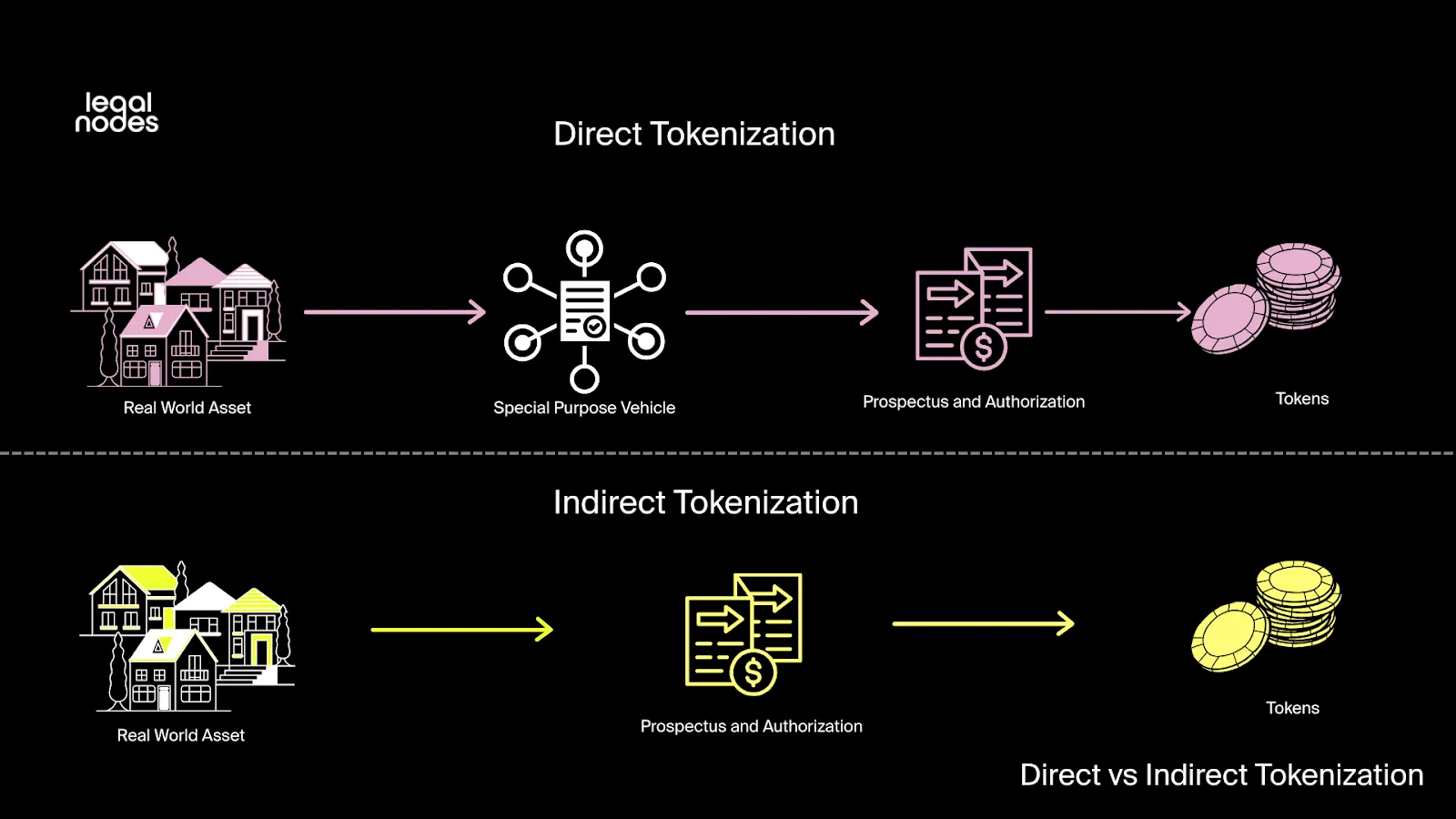
While institutional capital can be swiftly onboarded via private placement exemptions, offering tokenised assets to the general public strictly demands formal prospectus authorisation. For founders, this means navigating comprehensive public disclosures and securing explicit regulatory approvals, a rigorous but essential step to ensure retail protection.
How Legal Nodes Approaches Legal Engineering
Identifying the asset is only the preliminary step. The true intellectual property, and the key to unlocking global liquidity, lies in the legal wrapper.
The expansion of regulatory frameworks across sophisticated jurisdictions now allows us to architect highly tailored vehicles that protect both the founder and the investor.
Depending on the asset class and strategic goal, we typically engineer projects around one of three core frameworks.
The Securitisation Vehicle
Particularly effective for private credit and cash-flow-generating assets.
This involves transferring the underlying assets into a dedicated securitisation company, which then issues digital securities backed by those exact cash flows. It is the premier method for translating fragmented, illiquid debt into standardised digital bonds that can be confidently purchased by diverse investor tiers.
The Orphaned Special Purpose Vehicle (SPV)
The gold standard for single-asset tokenisation, such as a flagship commercial property.
The physical asset is placed into an SPV, the shares of which are held by an independent trust or foundation. This effectively "orphans" the asset from the founder’s operating company, providing absolute bankruptcy remoteness. If the technology layer falters, the investors' claims to the physical asset remain entirely insulated and legally sound.
The Tokenised Fund Structure
Designed for actively managed, dynamic portfolios. Utilising modern corporate structures, such as a Segregated Portfolio Company (SPC) or a Variable Capital Company (VCC), we architect the legal entity to issue digital tokens in place of traditional paper shares. This provides investors of all sizes with a legally recognised stake in a diversified pool of RWAs, complete with automated dividend distributions and programmed, automated compliance for secondary market trading.
In Conclusion
When legal engineering is treated as a strategic priority rather than an administrative afterthought, the commercial trajectory of an RWA project shifts fundamentally.
Founders who leverage these expanded structuring possibilities transition from managing localised, illiquid operations to governing globally accessible, programmable assets.
The precise alignment of asset class and legal framework unlocks true Capital Velocity. Your holdings cease to be stagnant; they become interoperable collateral, capable of circulating within decentralised finance ecosystems or being traded seamlessly on regulated alternative trading systems.
You mitigate counterparty risk, eliminate the friction of archaic settlement cycles, and crucially, you provide the structural certainty that allows anyone, from a retail participant to a Chief Risk Officer, to confidently allocate capital to your project.
The technology to mint a token has become commoditised, but the legal acumen required to make that token legally sound and globally investable remains a scarce premium.
At our firm, we recognise that a flawed legal structure is a vulnerability no amount of innovative code can fix.
We do not offer generic guidelines or off-the-shelf templates. We engineer bespoke financial bridges, translating your real-world assets into the rigorous legal architecture required by the modern capital markets. We ensure your structure is not merely compliant, but commercially optimised to capture the vast, diverse inflows of the digital economy.